
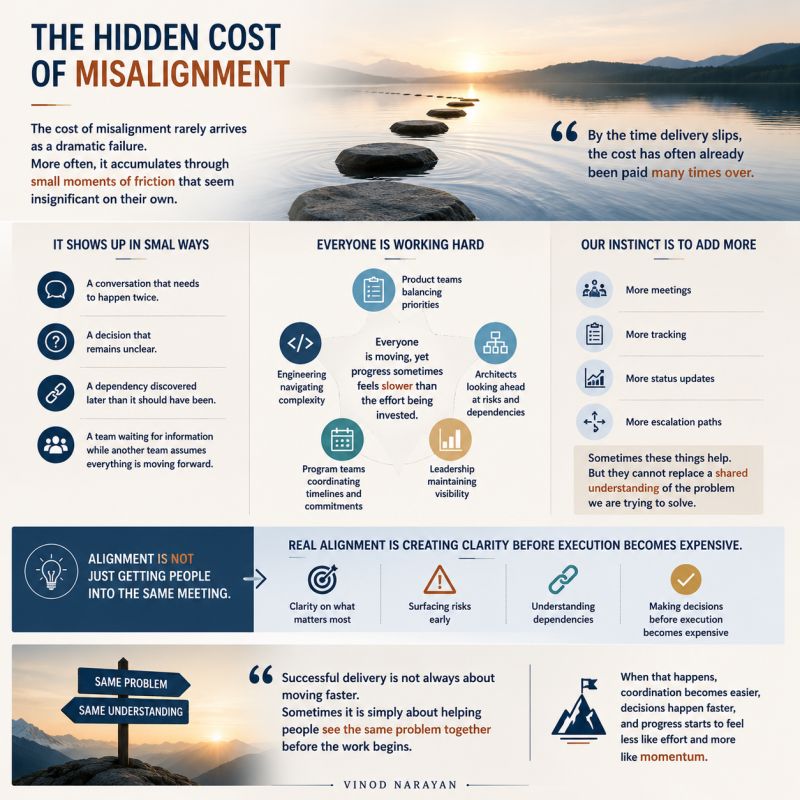
One thing I have noticed over the years is that the cost of misalignment rarely arrives as a dramatic failure. More often, it accumulates through small moments of friction that seem insignificant on their own.
It shows up in small ways. A conversation that needs to happen twice. A decision that remains unclear. A dependency discovered later than it should have been. A team waiting for information while another team assumes everything is moving forward.
By the time delivery slips, the cost has often already been paid many times over.
What makes this challenging is that everyone is usually working hard. Product teams are trying to balance priorities. Engineering teams are navigating complexity. Architects are looking ahead at risks and dependencies. Program teams are coordinating timelines and commitments. Leadership is trying to maintain visibility. Everyone is moving, yet sometimes progress feels slower than the effort being invested.
When that happens, our instinct is often to add more coordination. More meetings. More tracking. More status updates. More escalation paths.
Sometimes those things help. But they cannot replace a shared understanding of the problem we are trying to solve.
Over time, I have come to think that alignment is not about getting people into the same meeting. It is about helping people see the same reality. It is about creating clarity around priorities, surfacing risks early, understanding dependencies, and making decisions before execution becomes expensive.
The longer I work with teams, the more I wonder if successful delivery is not always about moving faster. Sometimes it is simply about helping people see the same problem together before the work begins.
When that happens I think coordination becomes easier, decisions happen faster, and progress starts to feel less like effort and more like momentum.
 Penpositive
Leave a comment