
One thing I am reminded of after every planning cycle is how much work happens before the planning event itself.
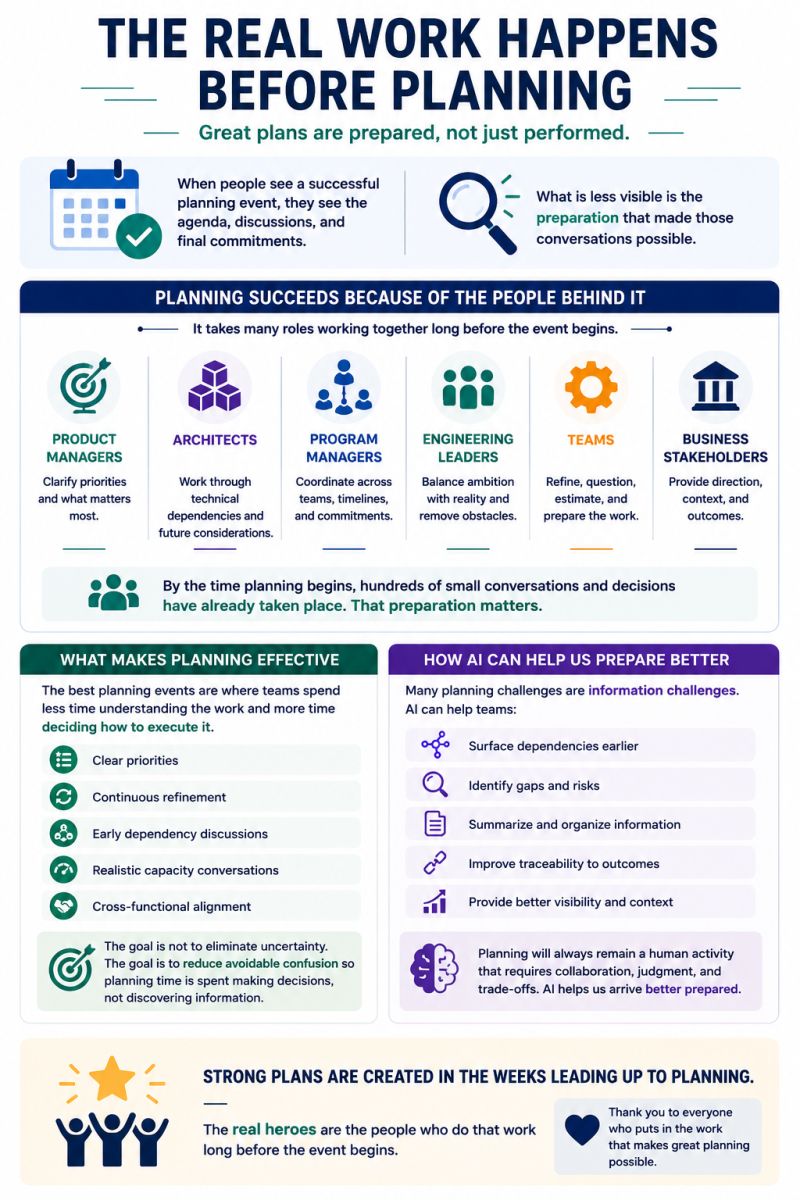
When people look at a successful planning event, they often see the agenda, discussions, and final commitments. What is less visible is the preparation that made those conversations possible.
Planning is rarely successful because of a facilitator, process, or framework alone. It succeeds because Product Managers clarify priorities, Architects work through dependencies, Program Managers coordinate across teams, Engineering leaders balance ambition with reality, and teams spend time refining and preparing.
The best planning events are often the ones where teams spend less time understanding the work and more time deciding how to execute it.
Clear priorities, continuous refinement, early dependency discussions, realistic capacity conversations, and cross-functional alignment are what make planning effective.
This is also where I believe AI can help. Many planning challenges are information challenges. AI can help teams surface dependencies earlier, identify gaps, improve traceability, and arrive with better context.
Planning will always remain a human activity that requires collaboration, judgment, and trade-offs. But AI can help teams arrive better prepared.
Strong plans are created in the weeks leading up to planning. The real heroes are the people who do that work long before the event begins.


Leave a Reply